
Why do I binge eat?
Understanding the Deeper Reasons Behind Binge Eating
If you find yourself asking, “Why do I binge eat?” you’re not broken, weak, or lacking discipline. Binge eating is not a failure of willpower — it’s a response to something deeper happening beneath the surface.
Many people who struggle with binge eating are intelligent, capable, and highly motivated in other areas of their lives. Yet when it comes to food, they feel out of control, ashamed, and confused by their behavior. This disconnect often leads to self-judgment and repeated attempts to “fix” the problem through more control, dieting, or restriction — which usually makes binge eating worse.
I get it. I struggled with binge eating for over 25 years and I’ve searching “why do I binge eat?” more times than I can count. Through my own experience, including 2 rounds of intensive outpatient therapy at an eating disorders treatment center, and working with hundreds of women around food and body image, eight core reasons for binge eating consistently emerge. While everyone’s experience is unique, these patterns help explain why binge eating happens and why it can feel so difficult to stop.
At the heart of all eight reasons is disconnection — from the body, emotions, nervous system, and sense of safety within oneself.
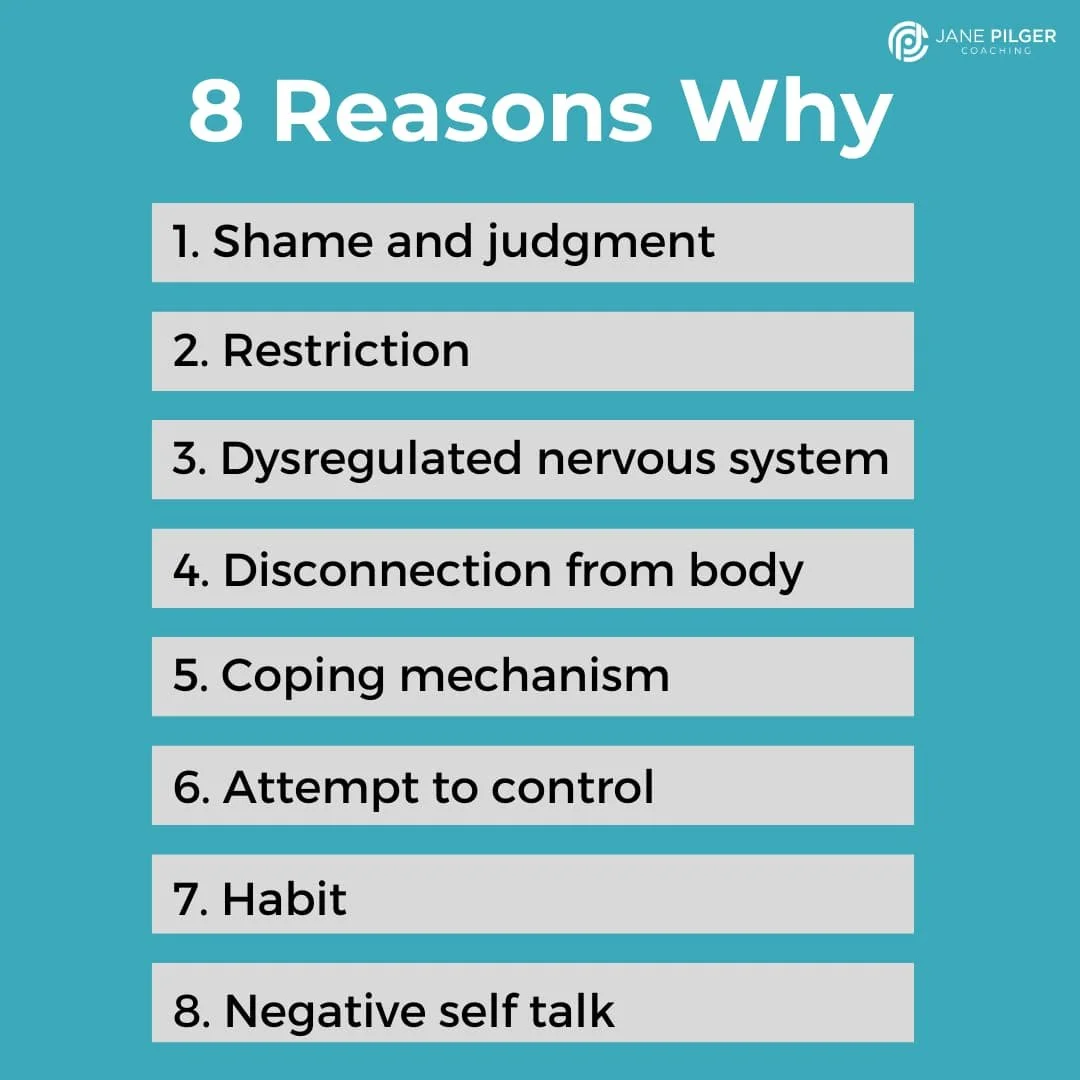
Read through these 8 reasons and see which ones resonate most. It’s not unusual for most, if not all of them, to be a factor in your binge eating.
1. Shame and Judgment Around Eating
One of the most common answers to the question “Why do I binge eat?” is shame.
Shame often develops early — through diet culture, family messages, or societal expectations about weight and appearance. Over time, eating becomes moralized: certain foods are labeled “good” or “bad,” and eating behaviors become something to judge rather than understand.
When shame is present, binge eating often happens in secret. People hide food, eat alone, or wait until no one is around. Afterward, intense self-judgment sets in, reinforcing the belief that something is wrong with them. This shame then creates emotional distress — which increases the urge to binge again.
Rather than motivating change, shame keeps the binge eating cycle alive.
2. Restriction: Physical and Mental
Restriction is one of the most powerful drivers of binge eating, even when it doesn’t look like a traditional diet.
Physical restriction occurs when the body isn’t receiving enough food to meet its energy needs. This can happen intentionally through dieting, skipping meals, or controlling portions, but it can also be unintentional due to busy schedules or ignoring hunger cues.
Mental restriction happens when foods are labeled as “off-limits,” “unhealthy,” or something you should only eat under certain conditions. Even if you’re eating enough calories, the belief that you shouldn’t have certain foods creates deprivation.
The body and brain interpret restriction as a threat. Binge eating becomes a biological and psychological response to restore balance and safety.
3. Nervous System Dysregulation
Binge eating is often closely tied to the state of the nervous system.
When stress, anxiety, overwhelm, or emotional intensity builds up in the body, the nervous system looks for a way to regulate. Food — especially highly palatable foods — can temporarily calm, numb, or discharge that excess energy.
For many people, binge eating isn’t about hunger at all. It’s about soothing a nervous system that has been pushed beyond its capacity. Without tools to regulate stress, emotions, or stimulation, binge eating becomes a fast and familiar way to cope.
4. Disconnection From the Body
Many people who struggle with binge eating are deeply disconnected from their bodies.
High achievers, caregivers, and those who pride themselves on being “strong” often override physical needs in favor of productivity or responsibility. Hunger, fatigue, and emotional signals are ignored day after day.
Eventually, the body finds a way to demand attention. Binge eating can become a forced pause — a moment of grounding, pleasure, or rest when needs have gone unmet for too long.
In this way, binge eating is not a lack of control, but an attempt to reconnect with the body.
5. Food as a Coping Mechanism
Another reason people binge eat is limited emotional capacity.
If you were never taught how to process emotions safely, food may have become one of the only available tools for comfort, distraction, or relief. This pattern is often learned in childhood and reinforced over time.
Binge eating in this context serves a purpose: it helps you survive overwhelming emotions. While it may no longer be helpful, it developed for a reason.
Healing binge eating requires expanding emotional capacity — not taking away the coping mechanism without offering support in its place.
6. Attempting to Control Food, Weight, or the Body
Paradoxically, binge eating is often fueled by a desire for control.
When life feels unpredictable or unsafe, controlling food or body size can feel like a way to regain stability. Diets, food rules, and rigid eating plans promise certainty and relief.
However, the more control is applied, the more pressure builds — and binge eating becomes the release valve. This cycle reinforces the belief that you cannot trust yourself around food.
Breaking free involves shifting from control to trust — trusting the body’s signals and your capacity to respond with care.
7. Habitual Patterns and Learned Associations
Binge eating can also become a habit rooted in the brain’s learning system.
Over time, the brain links binge eating with specific cues: certain times of day, emotional states, environments, or routines. These patterns can persist even when the original trigger is no longer present.
Habitual binge eating does not mean the behavior is permanent. With awareness, compassion, and repetition of new responses, these neural pathways can be gently rewired.
8. Your Personal Narrative and Inner Dialogue
The way you speak to yourself matters more than you may realize.
Thoughts like “I have no self-control,”“I can’t trust myself,” or “I’ll always struggle with food” shape behavior and reinforce disconnection. This internal narrative fuels shame and keeps binge eating in place.
Healing involves challenging these stories and replacing them with ones rooted in understanding, safety, and self-trust.
8 Reasons Why You Binge Eat or Feel Out of Control Around Food
Why Do I Binge Eat? A Question That Deserves Compassion
At its core, binge eating is not the problem — it is a response. Each of the eight reasons above points to a deeper need for connection, regulation, and care.
If you’re asking “Why do I binge eat?”, the answer is not that you’re failing. It’s that your body and nervous system are doing their best with the tools they have.
Approaching binge eating with curiosity instead of judgment opens the door to real healing. Awareness is the first step toward rebuilding trust with your body and creating a relationship with food that feels supportive rather than painful.
Discover More on the Podcast
Want a personalized assessment of why you binge and a plan for what to do next? Take the Why Do I Binge? quiz today.