
What to do after a binge
If you’ve just binged, you are likely feeling physically uncomfortable, emotionally overwhelmed, and mentally loud with self-criticism.
You may have just searched:
What do I do after a binge?
How do I recover from a binge?
How do I stop the binge eating cycle?
First — pause.
Binge eating is a complex behavior influenced by emotional, biological, and psychological factors. It is not a reflection of your worth, your discipline, or your character.
What you do in the hours after a binge matters far more than the binge itself.
And the most important thing?
Approach yourself with kindness and understanding.
Feeling Awful After a Binge and Wanting Relief
As you’re reading this, you’re probably in one of two camps:
You’ve recently binged or eaten a large amount of food. You feel miserable, disappointed, frustrated — and you want to know what to do right now.
You aren’t there at this exact moment, but you know exactly how that person feels because you’ve been there more times than you can count.
I can’t tell you how many times I Googled “what to do after a binge.” It became part of my pattern. I would binge, and when I finally stopped, I couldn’t stand to be with myself — physically or emotionally.
Often, this was after hours of eating food from the pantry, the bakery, the grocery store, or the convenience store.
I wanted to know:
How do I feel better right now?
How do I undo this?
How do I stop doing this so I don’t feel this way again?
What I found were articles about juice cleanses, detoxes, and strict reset plans — many of which were honestly triggering. What I didn’t find were grounded, compassionate steps that actually interrupted the binge-restrict cycle.
This is the resource I wish I had.
If you’ve just eaten a lot of food — or eaten in a way that doesn’t feel aligned with how you want to feel — here is exactly what to do next.
And if you haven’t? Bookmark this. Because preparation builds power.
What to Do After a Binge: A 5-Step Plan
These steps are designed to help you recover from a binge without making the cycle worse. Click here to get this plan in your inbox.
Step 1: Decide You’re Done (For Now)
One of the hardest parts of ending a binge is deciding that it’s actually over.
This becomes especially difficult if you are telling yourself that tomorrow you’ll be “perfect” and never do this again.
When your brain believes restriction is coming, it goes into “last supper” mode: “Get it in now. Tomorrow it might be taken away.”
You don’t need to promise yourself that you’ll never binge again.
You don’t need to swear off food for the rest of the day.
Instead, give yourself a short, defined pause — perhaps 1–2 hours — where you simply decide you are done eating for now.
Chances are, you are not physically hungry. The desire to continue eating is likely emotional or habitual momentum.
How do you solidify the decision?
Say it out loud: “I’m done eating for now.”
If possible, tell someone safe. If not, write it down. There is power in externalizing the decision instead of keeping it in your head.
You are not deciding to be perfect. You are deciding to interrupt momentum.
Step 2: Do Not Compensate
After a binge, the urge to “fix it” can be intense.
You may want to:
Skip your next meal
Start a strict diet tomorrow
Over-exercise
Cleanse or detox
Restrict carbohydrates or sugar
These behaviors feel productive — but they are the exact fuel that keeps the binge eating cycle alive.
Restriction → Deprivation → Urgency → Binge → Shame → Restriction.
Instead of compensating, return to balanced eating as soon as you are physically able.
That means:
Eat your next planned meal.
Include carbohydrates.
Hydrate normally.
Move your body gently if it feels supportive — not punitive.
Balanced nourishment stabilizes your nervous system and blood sugar. It signals safety to your body.
Compensation signals scarcity.
And scarcity perpetuates binge eating.
Step 3: Suspend the Shame
This step may be the hardest — and the most important.
Shame is the glue that holds binge eating in place.
As Brené Brown teaches, shame grows in secrecy. It thrives in darkness and isolation.
After a binge, your mind may say:
“I’m disgusting.”
“What’s wrong with me?”
“I have no self-control.”
But shame prevents curiosity. And curiosity is what creates change.
To suspend shame:
Tell one safe person what happened.
Journal honestly without filtering.
Ask yourself: What would I say to a friend in this exact situation?
You likely wouldn’t shame them. You would offer understanding.
Offer that same tone to yourself.
Step 4: Choose Curiosity and Compassion
You cannot access curiosity while actively judging yourself.
Imagine shame as a 50-pound weight on the hood of a car. You can’t look under the hood to see what’s happening while it’s there.
Once you soften shame, ask:
What do I need right now?
How does this make sense?
What was happening before this started?
Was there restriction earlier in the day?
Were you stressed?
Lonely?
Overstimulated?
Overtired?
Binge eating makes sense when you zoom out.
The goal is not to analyze yourself harshly. It is to understand the behavior so you can respond differently next time.
Step 5: Learn the Lesson
Every binge has something to teach you — if you are willing to look.
There is information inside the experience.
Ask:
What can I learn from this?
Where is there still room for growth?
What was I trying to get food to do for me?
Were you seeking comfort?
Relief?
Escape?
Reward?
Rebellion?
The binge is rarely about the food.
When you identify the need underneath the behavior, you create options.
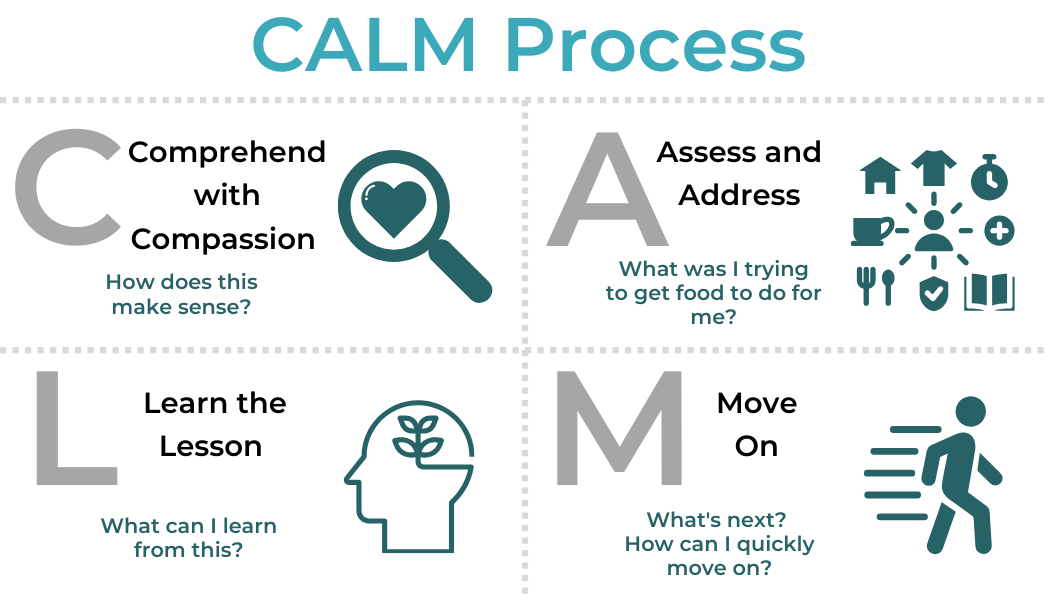
The CALM Process: A Simple Way to Remember What to Do After a Binge
In the moment, it can be hard to remember all of this. That’s why I created a simple framework: CALM.
C: Comprehend with Compassion
Ask:
How does this make sense?
What was happening for me?
Understanding replaces judgment.
A: Assess and Address
Ask:
What was I hoping the food would do for me?
How can I meet that need now in another way?
If you needed rest, rest.
If you needed comfort, seek comfort.
If you needed connection, reach out.
L: Learn the Lesson
Ask:
What do I learn from this experience?
What will I experiment with next time?
Not from punishment — but from growth.
M: Move On
Ask:
What’s next?
How quickly can I release this?
Moving on does not mean pretending it didn’t happen. It means refusing to relive it all day.
One binge does not define you.
How Do I Stop Binge Eating Completely?
You may be thinking:
“This is helpful. But how do I stop binge eating altogether?”
I understand that question deeply.
But here’s the truth:
Ending binge eating doesn’t happen through force. It doesn’t happen through perfection. It doesn’t happen through punishment.
It happens through repetition of a new response.
Every time you respond to a binge with calm instead of chaos…
With nourishment instead of restriction…
With curiosity instead of shame…
You weaken the cycle.
Resisting where you are right now only intensifies it.
Instead of demanding a binge-free future immediately, ask:
Can I practice a different response today?
This is how the cycle shifts.
Healing from binge eating is not linear. There will be setbacks. But each compassionate response builds resilience.
You absolutely can have a future where binge eating is no longer part of your life.
And that future begins not with control — but with compassion.
Right now.
You are not broken.
You are learning.
Discover More on the Podcast
Get the 5-Step Plan for What to Do After a Binge sent straight to your inbox. Click here.