
How do I stop binge eating?

If you’ve been asking yourself, “How do I stop binge eating?” you’re not weak, broken, or lacking discipline. You’re responding intelligently to something deeper that hasn’t been addressed yet.
Binge eating is not the problem. It’s the signal.
Binges are like lights on the dashboard. They don’t mean the car is bad, they mean something under the hood needs attention. When we focus only on stopping the behavior, we miss the opportunity to fix what’s actually driving it. When we address the root causes with compassion and curiosity, binge eating often resolves on its own.
This article explores how to stop binge eating by working with your body, nervous system, and emotions—not against them.
If you haven’t read the article Why do I binge eat? yet, you might check out that article first and then come back and read this one. It covers the 8 primary reasons why people binge eat or feel out of control around food.
Why Trying to “Control” Binge Eating Doesn’t Work
Most people try to stop binge eating by:
Creating stricter food rules
Cutting out trigger foods
Relying on willpower
Starting over repeatedly
While these approaches may work short term, they often backfire long term. That’s because binge eating isn’t a discipline problem—it’s a regulation strategy.
Your body and nervous system are always trying to keep you safe. When food becomes the fastest or most reliable way to regulate stress, emotions, or deprivation, binge eating makes sense.
Below are the 8 solutions to ending binge eating. Each solution goes along with the 8 primary reasons for binge eating identified in this article.
To stop binge eating sustainably, we have to understand why it became necessary in the first place.
1. Understand Why You Binge Eat
The foundation of binge eating recovery is understanding.
Ask yourself—not with judgment, but with curiosity:
When did binge eating begin?
What does it help me cope with?
What’s happening emotionally, physically, or mentally before a binge?
Understanding matters because it replaces shame with compassion. And shame is one of the biggest drivers of binge eating.
When you see binge eating as an adaptation rather than a failure, you can finally work with yourself instead of fighting yourself. This shift alone often reduces the intensity of urges.
2. Remove Food and Emotional Restrictions
Restriction is one of the most common causes of binge eating—yet it’s often invisible.
Restriction can look like:
Undereating or skipping meals
Labeling foods as “bad” or “off-limits”
Delaying hunger to feel in control
Restricting comfort, rest, or pleasure
When your body senses restriction, it responds with urgency. Binge eating becomes a biological response to perceived scarcity—not a lack of control.
To stop binge eating, restrictions—both physical and emotional—need to soften. This doesn’t mean chaos. It means consistency, permission, and nourishment.
Awareness is the first step:
Where am I saying “not yet” or “not allowed”?
Where am I pushing through hunger or exhaustion?
When restriction eases, binge urges often lose their intensity.
3. Work With Your Nervous System
Binge eating is closely tied to nervous system activation.
When your nervous system is overwhelmed, dysregulated, or shut down, your body looks for fast relief. Food is effective, accessible, and socially acceptable—so it becomes the tool.
If binge eating happens when you’re:
Stressed
Anxious
Overstimulated
Exhausted
Emotionally flooded
your nervous system is asking for support.
Learning how to regulate your nervous system—through slowing down, grounding, creating safety, and reducing chronic stress—can dramatically change your relationship with food. When the nervous system feels safer, binge eating becomes less necessary.
4. Reconnect With Your Body
Many people who binge eat are disconnected from their bodies—not by choice, but by necessity.
Dieting, trauma, chronic stress, and food rules all interfere with body awareness. Over time, hunger cues fade, fullness signals become confusing, and eating feels driven by the mind rather than the body.
Stopping binge eating requires rebuilding this connection.
This includes learning to:
Recognize physical hunger before it becomes extreme
Distinguish body needs from mental rules
Respond to cues with consistency rather than control
Your body is not the enemy. It’s communicating. Relearning how to listen—gently and patiently—is a crucial part of recovery.
5. Expand Emotional Capacity
For many people, binge eating is a way to manage emotions that feel too big, uncomfortable, or unsafe.
Food can temporarily:
Soothe anxiety
Numb pain
Distract from loneliness
Release tension
To stop binge eating, it’s not enough to remove food as a coping tool—you need to expand your emotional capacity.
Emotional capacity is your ability to be with emotions without immediately needing to escape them. This is a skill that develops over time through:
Allowing feelings without judgment
Learning that emotions pass
Building supportive regulation tools
As emotional capacity grows, binge eating naturally decreases because it’s no longer needed to carry what you can hold yourself.
6. Develop Two-Way Trust With Your Body
If you’ve cycled between restricting and binge eating, trust between you and your body may feel damaged.
Healing requires rebuilding two-way trust:
Trusting your body to communicate its needs
Helping your body trust you to respond consistently
This means:
Eating regularly
Eating enough
Responding to hunger without negotiation
Trust is not rebuilt through perfection—it’s rebuilt through repetition. Every time you nourish your body, you strengthen the relationship.
7. Break the Binge Eating Habit (Without Blame)
Binge eating can become habitual. Certain times, emotions, environments, or foods can automatically trigger the behavior.
Understanding these patterns is useful—but habit change alone is not enough.
Lasting change happens when habit work is combined with:
Nervous system regulation
Reduced restriction
Emotional support
Compassionate self-talk
Without these, breaking the habit often turns into another form of control. With them, change feels safer and more sustainable.
8. Change the Internal Dialogue Around Food and Your Body
Your inner voice matters.
Harsh self-talk fuels shame, and shame perpetuates binge eating. Shifting the internal dialogue is essential for recovery.
This doesn’t require forced positivity. It requires honesty and kindness.
Instead of:
“I failed again.”
Try:“Something inside me needed support.”
Instead of:
“I have no control.”
Try:“My body is communicating.”
Language shapes experience. Changing how you speak to yourself changes how safe your body feels—and safety is what ends binge eating.
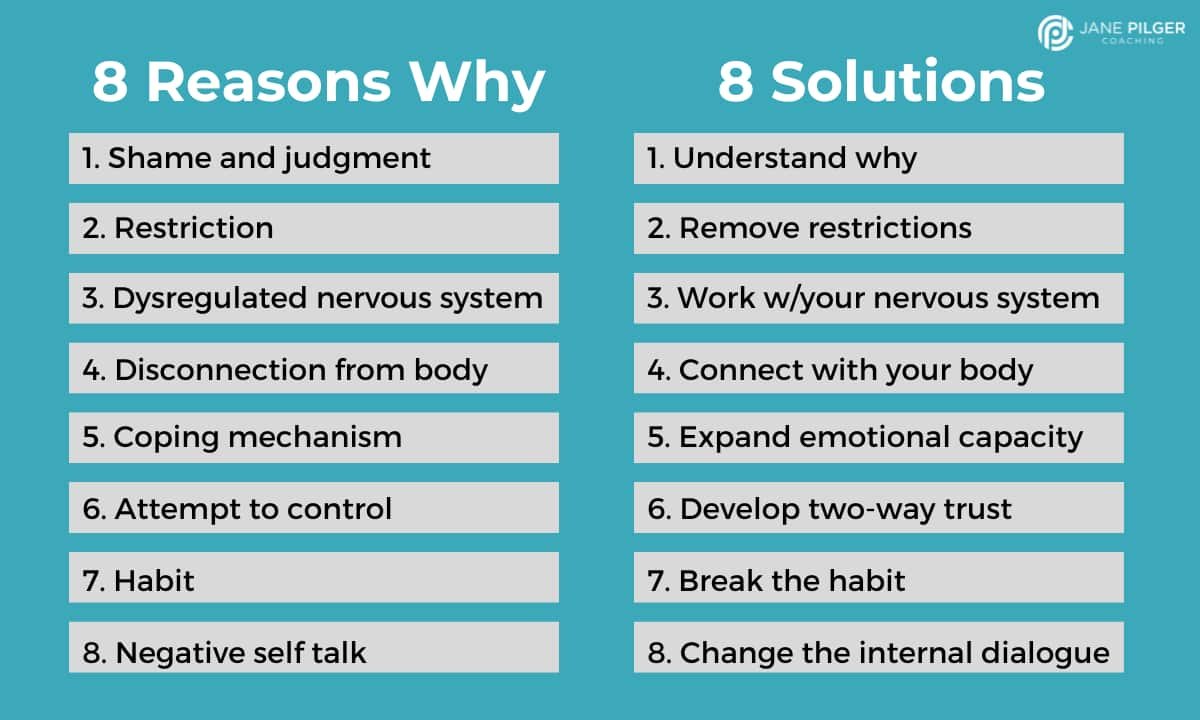
The 8 Reasons Why You Binge Eat and the 8 Solutions to Stop Binge Eating
What Binge Eating Recovery Actually Looks Like
Recovery is not the absence of binge urges. It’s a gradual change in your relationship with food, your body, and yourself.
Progress may look like:
Less urgency around food
More awareness before urges arise
Reduced shame after eating
Increased trust in your body
More peace and flexibility
Every step matters.
You Don’t Stop Binge Eating by Fighting Yourself
You stop binge eating by understanding yourself.
When you address the root causes—restriction, nervous system dysregulation, emotional overwhelm, and broken trust—binge eating no longer has a job to do.
Be patient. Start small. Practice compassion consistently.
Over time, binge eating can soften and release—not because you forced it to stop, but because you no longer needed it.
Discover More on the Podcast
In the Binge Breakthrough Mini Series I’ll help you understand what’s really going on - so you can stop binge eating for good. Watch now.